
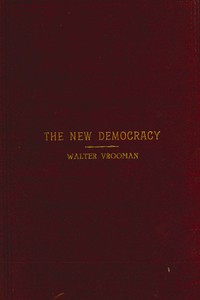
The New Democracy: A handbook for Democratic speakers and workers by Walter Vrooman
Published in 1899, Walter Vrooman's The New Democracy isn't a novel with a plot in the traditional sense. Think of it as a field manual. Vrooman was a co-founder of Ruskin College, a school for working-class adults, and this book is his attempt to put a powerful toolkit directly into their hands. He's writing for union organizers, local activists, and anyone who might have to give a speech at a town hall or debate a political opponent.
The Story
The 'story' here is the argument itself. Vrooman lays out what he sees as the fundamental sickness of American democracy at the turn of the 20th century: it's been captured by corporate monopolies (the 'trusts') and a stale two-party system. He believes true democracy—government by and for the people—is being suffocated. The book is structured as a series of lessons and talking points. He provides data on economic inequality, scripts for countering common arguments from the political establishment, and passionate appeals for building a new, independent people's movement. It's a step-by-step guide for constructing a persuasive case from the ground up.
Why You Should Read It
What grabbed me wasn't the specific economic data (some of which is, naturally, very dated), but the raw, fiery spirit of it. You can feel Vrooman's frustration and his hope bleeding through every page. It's a direct line to the political anxieties of the Progressive Era. Reading his complaints about money in politics, a disconnected elite, and a gridlocked system feels eerily familiar. It's a powerful reminder that the struggles we think are new have deep roots. More than that, it's a masterclass in persuasive writing for a cause. Vrooman understands emotion, logic, and how to frame an issue for maximum impact. You learn as much about communication as you do about history.
Final Verdict
This is a niche but fascinating read. It's perfect for history buffs who want to go beyond textbooks and hear an authentic, impassioned voice from the past. It's also great for anyone involved in activism, community organizing, or political communication—the core challenges of motivating an audience and dismantling an opponent's argument haven't changed much in 125 years. If you're looking for a neat narrative, this isn't it. But if you want to feel the pulse of a long-ago political fight and steal some timeless rhetorical tricks, pick up this handbook. It’s less of a relic and more of a mirror.







Carol Johnson
3 months agoVery helpful, thanks.